
History Timeline
1996
The Founding
 In 1996, the Peyton Anderson Foundation enabled a group of visionaries to start NewTown Macon which was founded as a public-private partnership to implement a coordinated, continuous plan for revitalizing downtown Macon. The mission is to invest time, resources, and money in local people and businesses to achieve a vision of a city led by locals that's booming and real. Since its inception, NewTown Macon has operated on a five-year capital campaign model for growth and sustainability. With each campaign, NewTown researches, measures, and evaluates benchmarks to streamline our efforts and priorities in five year increments. NewTown launches campaigns with the main priority to leverage massive economic and cultural benefits for our entire region by converting latent potential into a tangible reality. Capital campaigns allow NewTown to create a self-sustaining infrastructure to support downtown as an economic engine and cultural hub for all of Central Georgia. For the past 30 years, NewTown has gotten fingerprints over many rehabilitation and development projects downtown investing around 960 million dollars.
1996-2010
Phase 1: Foundations & Infrastructure
The inaugural era of NewTown Macon was defined by ambitious large-scale development and historic preservation. Following NewTown's founding in 1996, the organization launched its first comprehensive Urban Design Plan, shifting focus toward the bones of the city. The Community Challenge campaign launched in 1999 was a foundational $5 million local fundraising effort that successfully leveraged matching Challenge Grants from Peyton Anderson and Robert W. Woodruff Foundations to build a $36 million Capital Fund. High-impact projects during this phase included the restoration of the Terminal Station, the Ocmulgee Heritage Greenway, and Riverside Development. This phase was less about individual storefronts and more about creating the macro-infrastructure by restoring massive landmarks, assembling riverfront acreage, and building a world-class trail system to prove that downtown Macon was a viable destination for future investment. Phase 1 established the credibility and capital necessary to sustain decades of growth.
2002
Riverside Development
A cornerstone in the revitalization plan during this first phase was the seeding of a commercial development on 13 acres of property along the Ocmulgee River that is strategically connected to downtown. This project included the riverfront properties extending from Spring Street to Martin Luther King, Jr. Boulevard. NewTown Macon organized property acquisition, relocation of the public transportation authority and central services, site preparation and infrastructure development at a cost of $10 million.
2004
Capitol Theatre Renovation
NewTown decided to purchase and renovate the Capital Theatre in downtown Macon with the idea of it becoming a vessel to recapture Macon's musical heritage. Before NewTown came in, part of the roof had caved in, paint was peeling off the walls, and the floor was littered with holes.
2006
Ocmulgee Heritage Trail
In approximately 2001, the first section of walkable trail was installed across the river from Gateway Park, connecting the Otis Redding and Spring Street bridges. By 2006, over nine miles of the trail were constructed, an $8.5 million dollar project.
2010
Terminal Station Restoration
Built in 1916, the Terminal Station is one of the most architecturally significant buildings in Macon. One of NewTown’s first priority initiatives was to renovate Terminal Station by returning it to optimum commercial use while retaining its use as the hub for future inter-modal rail transportation. The renovation was designed by Alfred T. Fellheimer, the renowned architect behind New York’s Grand Central Terminal. Completed in 2010, it was restored to its former glory with a $5 million renovation.
2010-2013
Phase 2: Reputation & Connectivity
NewTown’s second campaign, The Welcome Home Campaign, kicked off Phase 2 which focused on marketing Macon’s historical beauty and reputation to attract locals back to Macon’s historic city center. Phase 1 laid down the groundwork for this phase by restoring and renovating iconic Macon landmarks and acquiring properties to bring locals in. During this phase, NewTown focused on storefront recruitment and small business support, successfully bringing 61 new enterprises to the downtown core. By providing gap financing and marketing Macon as a destination, this campaign triggered massive private investment in historic lofts and commercial spaces. NewTown was able to leverage over $135 million in restoration or construction.
2010
Established three Tax Allocation Districts
While the framework began earlier, NewTown assisted the City of Macon in fully leveraging three Tax Allocation Districts (TADs) to fund public improvements through future tax revenue. These included the Downtown TAD, the Renaissance/MLK TAD, and the Ocmulgee TAD.
2011
Cherry Street Plaza
This civic project beautified the block in front of Terminal Station and the Tubman Museum, creating a grand entrance to the city's museum district and improving pedestrian flow from the station to the river.
2012
Secured $5.5 Million Federal Grant for Amerson River Park
NewTown was instrumental in securing a federal grant in 2012. This funding was used to transform the former water works site into the current park, featuring the canoe launches, pavilions, and over 3 miles of paved trails that officially reopened to the public in 2015.
2013-2017
Phase 3: Downtown Revitalization & Density
The transition into Phase 3 marked a fundamental shift in strategy for NewTown Macon. The Focus on the Future campaign launched in 2012 and focused on a block-by-block approach to adding residents and businesses and creative ways of leveraging capital to reinvigorate downtown’s revitalization. Moving away from the grand landmark projects of the previous decade, this era prioritized human-scale, incremental growth and data-backed residential density. Under new leadership and guided by meticulous market research, NewTown began treating downtown as a living neighborhood rather than just a tourism destination. By focusing on filling the gaps between existing assets, this phase transformed the city center into a high-demand residential market and a self-sustaining ecosystem of local entrepreneurship.
2013
The Target Block Strategy
To maximize impact, NewTown concentrated resources on three specific "Target Blocks": the 400 block of Cherry Street, the 500 block of Cherry Street, and the third street corridor. These three “target blocks” were selected in consultation with the Middle Georgia Regional Commission because they had blighted and underutilized properties, and also because they are high traffic areas that have great assets, such as destination dining and the proximity to Second Street. By transforming the center of our city, NewTown created a ripple effect that spurred development throughout downtown.
2014
The Josh Rogers Presidency Begins
In April 2014, Josh Rogers transitioned from his role at Historic Macon Foundation to become President and CEO of NewTown Macon. Rogers had the unique ability to use market economics to meet the needs of Maconites and match philanthropic investments. He introduced a data-driven philosophy rooted in the principles of incremental development. This shift moved the organization’s focus toward small-scale property owners and local entrepreneurs, emphasizing that dozens of small improvements create more long-term stability than a single massive development.
2015
Residential Density Push
NewTown’s most successful initiative for increasing residents has been to provide gap financing to developers through the NewTown Development Loan Fund. This loan fund converts vacant spaces to residential or commercial units, increases property tax revenue, creates construction jobs, and improves the aesthetics of Downtown Macon. With the Development Loan Funds, NewTown Macon invested $5 million in eight downtown projects with a total value of $26.1 million by 2015. These completed projects have converted more than 250,000 square feet of abandoned space to 182 lofts and 17 commercial units. As of July 2015, there was a 99% loft occupancy rate showing that people wanted to live downtown and not just visit.
2017-2022
Phase 4: Focusing on the Local
This phase focused on establishing a physical and organizational foundation for downtown Macon by implementing the community-led Macon Action Plan (MAP). During this phase, the primary objectives were to double market-rate loft housing to over 1,000 units and achieve 80% storefront occupancy within three specific "target blocks". This era also prioritized physical connectivity, specifically linking neighborhoods to the Ocmulgee Heritage Trail and advocating for the Ocmulgee National Monument to receive National Historical Park status. These efforts were supported by a $6.5 million capital campaign and the growth of the private Godsey Initiatives Fund.
2017
The Business Improvement District
In July 2017, downtown property owners voted to establish the Business Improvement District (BID). This allowed owners to tax themselves to fund services beyond what the city provided. The BID funded the "Clean and Safe" program, introducing the recognizable ambassadors who provide hospitality and maintenance. Since its inception, property values within the BID have seen a staggering 83% surge.
2018
Developer Academy Launch
The Developer's Academy is an intensive six-class course designed to equip aspiring developers with the necessary skills to undertake real estate projects in downtown Macon. With a focus on bridging the gap between available housing stock and the interests of local developers, this program provides participants with the resources, connections, and knowledge needed to succeed in real estate development.
2018
Entrepreneurship Academy Launch
The Entrepreneur's Academy, launched by NewTown Macon in 2018 with the support of Knight Foundation and in collaboration with the University of Georgia's JW Fanning Institute for Leadership Development, is a comprehensive training program designed for aspiring and growth-oriented entrepreneurs. With a focus on developing informed business plans and securing funding, the academy empowers participants to turn their ideas into successful ventures.
2018
CDFI Certification
In September 2018, NewTown Macon officially became a Community Development Financial Institution (CDFI), the first of its kind in Central Georgia. This status allowed NewTown to access federal funds to provide loans to entrepreneurs. This was a catalyst for diversity; by the end of 2018, NewTown reached a milestone where 30% of downtown storefronts were Black-owned, significantly outpacing national averages for downtown districts.
2021
Ocmulgee Heritage Trail Improvements
As of 2021, 13 miles of the Ocmulgee Heritage Trail had been constructed and a total of 5 bridges were installed. Three connections were underway that would increase the walkability of residents by gradually connecting the trail to downtown neighborhoods.
2022-Present
Phase 5: Ownership, Legacy, and Creating Self-Sustainability
The current phase builds upon NewTown’s first 25 years of success, and downtown’s newfound confidence, to accelerate the growth of downtown Macon with a focus on investing in local entrepreneurs and real estate developers. With the Leveraging Local Campaign launched in 2022, NewTown’s goal is to produce $100 million in new local investment. This initiative specifically focuses on equipping locals by providing the financing, training, and resources necessary for 20 renting entrepreneurs to purchase their buildings. This move shifts the economic power from outside landlords to the local business owners who drive downtown's daily vibrancy.
February 2022
Hotel 45 Ribbon Cutting
The opening of Hotel 45, a Tribute Portfolio boutique hotel, represented a landmark $39 million adaptive reuse of the historic Bankers Insurance Building. As the first high-end boutique hotel in the city center, it transformed the Cotton Avenue District and signaled Macon's transition into a competitive overnight tourism market, creating a new anchor for downtown hospitality.
2024
National Validation: Great American Main Street Award
In May 2024, Macon received the nation’s highest honor for downtown revitalization: the Great American Main Street Award (GAMSA). Main Street America recognized NewTown for its data-driven approach to residential density and its industry-leading success in diversity.
2024
Marketing Academy Launch
NewTown Macon's Marketing Academy is a groundbreaking initiative designed to equip entrepreneurs with essential digital marketing skills. Developed in collaboration with industry experts and powered by a grant from the Georgia Power Foundation, the academy offers immersive training to drive business growth in Macon's vibrant community.
2026
Bibb Theatre Rehabilitation
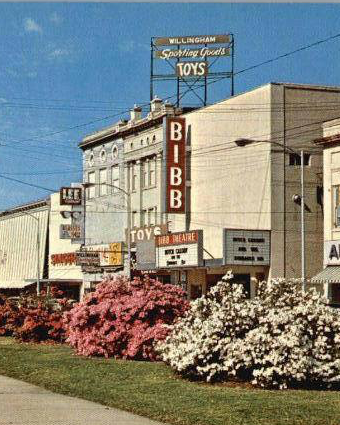
With the help of the Peyton Anderson Foundation, NewTown was able to buy the Bibb Theatre in 2018. After standing vacant for 47 years, NewTown announced official rehabilitating plans for the Bibb Theatre. In an effort to revive the downtown spot, NewTown will use the area as a coworking space for Visit Macon's Rock Candy Tours and the Creek 100.9 FM.
2026
Neel's Lofts Completion
The Neel's Lofts project is a $32 million mixed-use flagship. By converting the historic Neel’s Department Store into 95 luxury lofts and significant ground-floor retail, this project provides the critical residential mass needed to sustain long-term urban growth and retail demand in the heart of the core.
Downtown Development Outlook
120 Hotel Rooms & 250 Lofts
Mercer Medicine
280 Hotel Rooms
Convention Center
57 Lofts
7th Street Lofts
95 Lofts
Neels Lofts
160 Hotel Rooms
Opterra Hotel Dev.
146 Lofts
Lofts at D. T. Walton
100 Hotel Rooms
Macon Health Club
90 Offices
691 Cherry Street